| dc.contributor.author | Eskin, Berna Terzi | |
| dc.date.accessioned | 2025-07-10T07:40:31Z | |
| dc.date.available | 2025-07-10T07:40:31Z | |
| dc.date.issued | 2025 | en_US |
| dc.identifier.citation | ESKİN, Berna Terzi. "Cumhuriyet’in Yeni Kadınını Yazmak: Huzur’da Erkek Muhayyilenin Politik Sentezciliğine Karşı Kadın Kahramanın Öznellik Direnci". Yakın Dönem Türkiye Araştırmaları, 47 (2025): 267-282. | en_US |
| dc.identifier.uri | https://iupress.istanbul.edu.tr/tr/journal/rpts/article/cumhuriyetin-yeni-kadinini-yazmak-huzurda-erkek-muhayyilenin-politik-sentezciligine-karsi-kadin-kahramanin-oznellik-direnci | |
| dc.identifier.uri | https://hdl.handle.net/11352/5347 | |
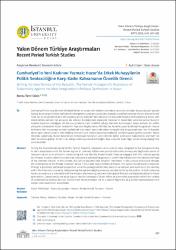
| dc.description.abstract | Cumhuriyet’in kuruluş döneminde klasik kültür ve sanat, eski rejimden devralınan unsurlar olmaları dolayısıyla geri planda
kalmış; buna karşılık folklor, istifade edilmesi gereken yegâne ulusal kültür kaynağı olarak konumlandırılmıştır. Ahmet Hamdi
Tanpınar da bu gündeme dair söz söylemiş, ancak alternatif denilebilecek bir söylemle folkloru ve İmparatorluk mirası olan
klasik kültürü sentezci bir anlayışla ele almıştır. Bu bağlamda makalede, Tanpınar’ın Huzur’daki kadın kahraman Nuran’ın
karakter tasarımı aracılığıyla söz konusu gündeme nasıl müdâhil olduğu üzerinde durulmuştur. Yazar, sentezci bir politik
yaklaşımı önceleyerek Nuran karakterini inşa eder. Başkahraman Mümtaz ise Nuran’ın yazar tarafından kurgulanan mevcut
birikimine dair manzarayı yeniden keşfederek onu roman içerisinde tekrar tahayyül edip kurgulamak ister. Her iki koşulda
da bir kadın olarak Nuran’a hem folkloru hem de klasik kültürü saklama ve gelecek nesillere taşıma vazifesi yüklenir. Netice
itibariyle çalışmada, Nuran karakteriyle somutlaşan tablonun yakın dönem kültür politikaları bağlamında alternatif bir
teklif anlamına geldiği, Nuran’ın da edilgen kalmayıp kendi öznelliğini dışa vuran bir kadın figür olarak belirginleştiği öne
sürülmektedir. | en_US |
| dc.description.abstract | During the foundational period of the Turkish Republic, classical culture and art were relegated to the background due
to their associations with the former regime. In contrast, folklore was positioned as the primary and legitimate source of
national culture to be utilized in constructing the new identity. Ahmet Hamdi Tanpınar engaged with this cultural agenda,
but through an alternative discourse that embraced a synthesizing approach, combining folklore with the classical heritage
of the Ottoman Empire. In this context, this article explores how Tanpınar intervenes in this cultural discussion through
the construction of the female character Nuran in his novel Huzur (A Mind at Peace). The author builds Nuran’s character
through a politically synthesist perspective, while the protagonist Mümtaz seeks to reinterpret and reconstruct her identity
within the fictional universe by rediscovering the cultural depth previously ascribed to her by the author. In both instances,
Nuran, as a woman, is entrusted with the mission of preserving and transmitting both folklore and classical culture to future
generations. Consequently, the study argues that the portrayal of Nuran offers an alternative proposition within the context
of contemporary cultural policies. Furthermore, Nuran emerges not as a passive figure but as a distinct representation of a
woman who asserts her subjectivity. | en_US |
| dc.language.iso | tur | en_US |
| dc.publisher | İstanbul University Press | en_US |
| dc.relation.isversionof | 10.26650/YTA2025-1574524 | en_US |
| dc.rights | info:eu-repo/semantics/openAccess | en_US |
| dc.subject | Kültür Politikaları | en_US |
| dc.subject | Kadın Çalışmaları | en_US |
| dc.subject | Huzur | en_US |
| dc.subject | Ahmet Hamdi Tanpınar | en_US |
| dc.subject | Folklor | en_US |
| dc.subject | Cultural Policy | en_US |
| dc.subject | Women’s Studies | en_US |
| dc.subject | Huzur | en_US |
| dc.subject | Ahmet Hamdi Tanpınar | en_US |
| dc.subject | Folklore | en_US |
| dc.title | Cumhuriyet’in Yeni Kadınını Yazmak: Huzur’da Erkek Muhayyilenin Politik Sentezciliğine Karşı Kadın Kahramanın Öznellik Direnci | en_US |
| dc.title.alternative | Writing the New Woman of the Republic: The Female Protagonist’s Resistance of Subjectivity against the Male Imagination’s Political Synthesism in Huzur | en_US |
| dc.type | article | en_US |
| dc.relation.journal | Yakın Dönem Türkiye Araştırmaları | en_US |
| dc.contributor.department | FSM Vakıf Üniversitesi, Edebiyat Fakültesi, Türk Dili ve Edebiyatı Bölümü | en_US |
| dc.contributor.authorID | https://orcid.org/0000-0002-3169-9171 | en_US |
| dc.identifier.issue | 47 | en_US |
| dc.identifier.startpage | 267 | en_US |
| dc.identifier.endpage | 282 | en_US |
| dc.relation.publicationcategory | Makale - Uluslararası Hakemli Dergi - Kurum Öğretim Elemanı | en_US |
| dc.contributor.institutionauthor | Eskin, Berna Terzi | |