| dc.contributor.author | Tanrıverdi, Zeynep | |
| dc.contributor.author | Akyol, Ali Akın | |
| dc.contributor.author | Kadıoğlu, Yusuf Kağan | |
| dc.date.accessioned | 2025-11-14T08:36:05Z | |
| dc.date.available | 2025-11-14T08:36:05Z | |
| dc.date.issued | 2025 | en_US |
| dc.identifier.citation | TANRIVERDİ, Zeynep, Ali Akın AKYOL & Yusuf Kağan KADIOĞLU. "Ankara Roma (Caracalla) Hamamı Taşıyıcı, Isıtma ve Su Sistemlerinde Kullanılan Pişmiş Toprak Malzemelerin Ham Madde Özellikleri". TÜBA-KED Türkiye Bilimler Akademisi Kültür Envanteri Dergisi, 31 (2024): 11-31. | en_US |
| dc.identifier.uri | https://dergipark.org.tr/tr/pub/tubaked/issue/92398/1478548 | |
| dc.identifier.uri | https://hdl.handle.net/11352/5705 | |
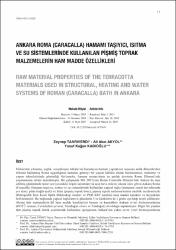
| dc.description.abstract | Mimarinin yıkanma, sağlık, sosyalleşme taleplerini karşılayan hamam yapılarının inşasına antik dönemlerden
itibaren başlanmış Roma uygarlığının hamama gitmeyi bir yaşam kültürü olarak benimsemesi, malzeme ve
yapım teknolojisinde gösterdiği ilerlemeler, hamam mimarisinin en parlak devrinin Roma Dönemi’nde
yaşanmasına ortam hazırlamıştır. Bu çalışmada MS 200’lerde Roma Caracalla Dönemi’nde Ankara’da inşa
edilmiş günümüzde temel seviyesindeki özgün kalıntılarıyla açık hava müzesi olarak işlev gören Ankara Roma
(Caracalla) Hamamı taşıyıcı, ısıtma ve su sistemlerinde kullanılan yapısal tuğla (hamamın temel duvarlarında
yer alan), pilae (tuğla ayak) ve künk (pişmiş toprak boru); pişmiş toprak malzemelerinin analitik incelemelerle
(Petrografik İnce Kesit Optik Mikroskop Analizi ve PED-XRF Analizi) ham madde karakter ve kaynakları
belirlenmiştir. Bu bağlamda yapısal tuğlaların 6, pilaelerin 5 ve künklerin d e 2 gruba ayrıldığı tespit edilmiştir.
Alınan tüm numunelerin kil ham madde karakterleri benzer ve kaynakları Ankara civarı formasyonlarına
(ODTÜ ormanı, Cevizlidere çevresi, Yenidoğan civarı ve Tandoğan) ait olduğu saptanmıştır. Diğer bir yandan
tüm pişmiş toprak örnek çeşitlerinde kullanılan agregaların Ankara’nın yakın çevre yerel formasyonlarına (andezit agregası-Hüseyingazi Kale, granit agregası-Bağla Köprüköy, metagrovak agregası-Güney Ankara yerel
formasyonu) ait olduğu görülmüştür. Bu analizler sonucunda tüm malzemelerin yerel, yakın çevreden elde edilip
aynı dönemde ve atölyelerde üretilmiş olduğu belirlenmiştir. Bu veriler ışığında, Roma Dönemi’nde Ankara’da
yıkanma ihtiyacını karşılayan hamamın inşasında; erişim kolaylığı, ekonomiklik, hızlı üretim, mevcut çevreye
uyum açısından Ankara’ya yakın yerel ham madde kaynaklarından yararlanıldığı anlaşılmıştır. | en_US |
| dc.description.abstract | The construction of baths, designed to meet the architectural demands for bathing, health and socialization, dates back
to ancient times. The Roman civilization’s adoption of bathing as a cultural practice, combined with advancements
in materials and construction technology, facilitated the flourishing of bath architecture during the Roman Period.
In this study, the structural bricks (located on the foundation walls of the bath), pilae stacks (brick supports), and
pipes (terracotta pipes) used in the structural, heating, and water systems of the Roman (Caracalla) Bath in Ankara
were analyzed. This bath, constructed in Ankara during the Roman Caracalla Period in 200 AD, currently functions
as an open-air museum, preserving its original remains at the foundation level. The raw material characteristics
and sources of these terracotta materials were determined through analytical methods, including Petrographic Thin
Section Optical Microscope and PED-XRF Analyses. In this context, the structural bricks were categorized into six
groups, the pilae stacks into five groups, and the pipes into two groups. The clay raw materials of all the samples
exhibited similar characteristics, with their sources traced to formations around Ankara (specifically the METU
forest, Cevizlidere, Yenidoğan area, and Tandoğan). On the other hand, it was observed that the aggregates used in all
terracotta sample types originated from local formations in Ankara (specifically andesite aggregate from Hüseyingazi
Kale, granite aggregate from Bağla Köprüköy, and metagrovac aggregate from the southern Ankara formation). As a
result of these analyses, it was determined that all the terracotta materials were sourced locally, from the immediate
vicinity, and were produced within the same period and workshops. In the light of these findings, it is evident that
local raw material resources near Ankara were utilized for their ease of access, cost-effectiveness, rapid production,
and adaptability to the existing environment in the construction of the baths that fulfilled the need for bathing in
Ankara during the Roman period. | en_US |
| dc.language.iso | tur | en_US |
| dc.publisher | Türkiye Bilimler Akademisi | en_US |
| dc.relation.isversionof | 10.22520/tubaked.1478548 | en_US |
| dc.rights | info:eu-repo/semantics/openAccess | en_US |
| dc.subject | Ankara Roma (Caracalla) Hamamı | en_US |
| dc.subject | Hamam Isıtma (Hypokaust) Sistemi | en_US |
| dc.subject | Hamamda Su Sistemi | en_US |
| dc.subject | Malzeme ve Üretim Teknolojileri | en_US |
| dc.subject | Pişmiş Toprak Malzeme | en_US |
| dc.subject | Roman (Caracalla) Bath in Ankara | en_US |
| dc.subject | Bath Heating System (Hypocaust) | en_US |
| dc.subject | Water System in Bath, Materials and Production Technologies | en_US |
| dc.subject | Terracotta Materials | en_US |
| dc.title | Ankara Roma (Caracalla) Hamamı Taşıyıcı, Isıtma ve Su Sistemlerinde Kullanılan Pişmiş Toprak Malzemelerin Ham Madde Özellikleri | en_US |
| dc.title.alternative | Raw Material Properties of The Terracotta Materials Used in Structural, Heating and Water Systems of Roman (Caracalla) Bath in Ankara | en_US |
| dc.type | article | en_US |
| dc.relation.journal | TÜBA-KED Türkiye Bilimler Akademisi Kültür Envanteri Dergisi | en_US |
| dc.contributor.department | FSM Vakıf Üniversitesi | en_US |
| dc.contributor.authorID | https://orcid.org/0000-0002-4151-9744 | en_US |
| dc.contributor.authorID | https://orcid.org/0000-0002-4174-575X | en_US |
| dc.contributor.authorID | https://orcid.org/0000-0002-7894-2220 | en_US |
| dc.identifier.issue | 31 | en_US |
| dc.identifier.startpage | 11 | en_US |
| dc.identifier.endpage | 31 | en_US |
| dc.relation.publicationcategory | Makale - Uluslararası Hakemli Dergi - Kurum Öğretim Elemanı | en_US |
| dc.contributor.institutionauthor | Tanrıverdi, Zeynep | |