| dc.contributor.author | Bozkurt, Eshabil | |
| dc.date.accessioned | 2024-12-30T14:13:16Z | |
| dc.date.available | 2024-12-30T14:13:16Z | |
| dc.date.issued | 2024 | en_US |
| dc.identifier.citation | BOZKURT, Eshabil. "Osmanlı Türkçesinde Bir Aslına Çeviri Örneği: François Coppée’nin La Tête de la Sultane Başlıklı Manzumesi ve Hikâye-i Feth Başlıklı Çevirisi". FSM İlmî Araştırmalar İnsan ve Toplum Bilimleri Dergisi, 24 (2024): 27-49. | en_US |
| dc.identifier.uri | https://hdl.handle.net/11352/5144 | |
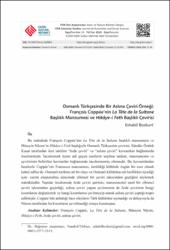
| dc.description.abstract | Bu makalede François Coppée’nin La Tête de la Sultane başlıklı manzumesi ve
Hüseyin Nâzım’ın Hikâye-i Feth başlığıyla Osmanlı Türkçesine çevirisi, Sündüz Öztürk
Kasar tarafından ileri sürülen “özde çeviri” ve “aslına çeviri” kavramları bağlamında
incelenmiştir. İncelenmek üzere adı geçen eserlerin seçilme nedeni, manzumenin ve
çevirisinin belirtilen kavramlar bağlamında incelenmemiş olmasıdır. Bu kavramlardan
hareketle Coppée’nin Fransızca manzumesi, üretildiği kültürde özgün bir eser olarak
kabul edilse de -Osmanlı tarihine ait bir olayı ve Osmanlı kültürüne ait özellikleri içerdiği
için- eserin oluşturulma sürecinde zihinsel bir çeviri sürecinden geçtiğini söylemek
mümkündür. Yapılan incelemede özde çeviri şairinin, manzumesini nasıl bir zihinsel
çeviri işleminden geçirdiği, aslına çeviri yapan çevirmenin de özde çevirinin hangi
kısımlarını değiştirerek ve hangi kısımlarını çevirmeyip atarak aslına çeviri yaptığı tespit
edilmiştir. Coppée’nin anlattığı bazı olayların Türk kültürüne uymadığı ve dolayısıyla da
Nâzım tarafından bu kısımların çevrilmediği ortaya konmuştur. | en_US |
| dc.description.abstract | In this article, François Coppée’s poem La Tête de la Sultane and its translation
into Ottoman Turkish by Hüseyin Nâzım titled Hikâye-i Feth were analysed within the
framework of “watermark translation” and “retro-translation” propounded by Sündüz
Öztürk Kasar. The reason why the aforementioned works were selected for analysis is that
this poem and its translation have not been analysed within the framework of the stated
concepts. Based on these concepts, it is possible to say that although the poem in French
by Coppée is considered an original work in the culture in which it was produced -since
it contains an event from Ottoman history and features belonging to Ottoman culture- it
went through a mental translation process during the creation of the work. In the analysis
focusing on the concepts of “watermark translation” and “retro-translation”, how the poet
of watermark translation goes through a mental translation process was examined, in
addition to determinig which parts of the retro-translation were changed or eliminated.
It was revealed that some of the events narrated by Coppée were not suitable for Turkish
culture and therefore these parts were not translated by Nâzım. | en_US |
| dc.language.iso | tur | en_US |
| dc.publisher | FSM Vakıf Üniversitesi | en_US |
| dc.relation.isversionof | 10.16947/fsmia.1609804 | en_US |
| dc.rights | info:eu-repo/semantics/openAccess | en_US |
| dc.subject | François Coppée | en_US |
| dc.subject | La Tête de la Sultane | en_US |
| dc.subject | Hüseyin Nâzım | en_US |
| dc.subject | Hikâye-i Feth | en_US |
| dc.subject | Özde Çeviri | en_US |
| dc.subject | Aslına Çeviri | en_US |
| dc.title | Osmanlı Türkçesinde Bir Aslına Çeviri Örneği: François Coppée’nin La Tête de la Sultane Başlıklı Manzumesi ve Hikâye-i Feth Başlıklı Çevirisi | en_US |
| dc.title.alternative | An Example of Retro-translation into Ottoman Turkish: François Coppée’s Poem Titled La Tête de la Sultane and Its Translation Titled Hikâye-i Feth | en_US |
| dc.type | article | en_US |
| dc.relation.journal | FSM İlmî Araştırmalar İnsan ve Toplum Bilimleri Dergisi | en_US |
| dc.contributor.department | FSM Vakıf Üniversitesi, Rektörlük, FSM İlmî Araştırmalar İnsan ve Toplum Bilimleri Dergisi | en_US |
| dc.contributor.authorID | https://orcid.org/0000-0003-2577-5315 | en_US |
| dc.identifier.issue | 24 | en_US |
| dc.identifier.startpage | 27 | en_US |
| dc.identifier.endpage | 49 | en_US |
| dc.relation.publicationcategory | Makale - Ulusal Hakemli Dergi - Başka Kurum Yazarı | en_US |