| dc.contributor.author | al-Hashimi, Anmar | |
| dc.date.accessioned | 2025-07-21T10:44:57Z | |
| dc.date.available | 2025-07-21T10:44:57Z | |
| dc.date.issued | 2025 | en_US |
| dc.identifier.citation | al-HASHİMİ, Anmar. "أهمية العامل الروحي ودوره في المشروع الحضاري للمفكر مالك بن نبي". Afkar: Jurnal Akidah & Pemikiran Islam, 27.1 (2025): 589-632. | en_US |
| dc.identifier.uri | https://ejournal.um.edu.my/index.php/afkar/article/view/57662 | |
| dc.identifier.uri | https://hdl.handle.net/11352/5352 | |
| dc.description.abstract | اهتم المفكر مالك بن نبي بمصطلح الروح، لذا استخدم العديد من
المفاهيم والعبارات في أغلب مؤلفاته تدلل على ذلك المصطلح وترتبط
به وتبرز أثره والتي منها: العامل الروحي، البعث الروحي، روح الحضارة،
روحية الإسلام، روح الحضارة الإسلامية، روح المؤمن، الروح الكلي،
المخزون الروحي، وغيرها من المصطلحات. استخدام ابن نبي لهذه
المصطلحات العديدة في مشروعه الحضاري يدلل على أهمية هذا
العامل، ودوره في إيجاد الحضارات، لذلك قرر أن إنشاء الحضارات
يعتمد على وجود عاملين أساسيين هما: الفكر والروح . | en_US |
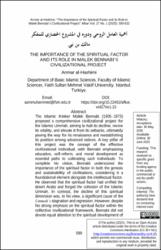
| dc.description.abstract | The Islamic thinker Malek Bennabi (1905–1973) proposed a comprehensive civilizational project for the Islamic Ummah, aiming to halt its decline, revive its vitality, and elevate it from its setbacks, ultimately paving the way for its renaissance and reestablishing its position among advanced nations. A key pillar of this project was the concept of the effective civilizational individual, with Bennabi emphasising education, self-reform, and moral development as essential paths to cultivating such individuals. To complete his vision, Bennabi underscored the importance of the spiritual factor in both the genesis and sustainability of civilisations, considering it a foundational element alongside the intellectual factor. He observed that the spiritual factor had unified the desert Arabs and forged the cohesion of the Islamic Ummah. In contrast, the decline of this spiritual dimension was, in his view, a significant cause of the Ummah’s stagnation and regression. However, despite his strong emphasis on the spiritual factor within the collective civilizational framework, Bennabi did not devote equal attention to the spiritual development of the individual. Accordingly, this study seeks to illuminate the role of the spiritual factor in Bennabi’s civilizational thought, investigate the reasons for his limited focus on the individual’s spiritual reformation, and explore the foundational concepts and methodologies for addressing this dimension. | en_US |
| dc.language.iso | ara | en_US |
| dc.publisher | Universiti Malaya | en_US |
| dc.relation.isversionof | 10.22452/afkar.vol27no1.15 | en_US |
| dc.rights | info:eu-repo/semantics/openAccess | en_US |
| dc.subject | Islamic Thought | en_US |
| dc.subject | Malek Bennabi | en_US |
| dc.subject | The Spiritual Factor | en_US |
| dc.subject | Islamic Civilisation | en_US |
| dc.subject | Islamic Spiritual Work | en_US |
| dc.title | أهمية العامل الروحي ودوره في المشروع الحضاري للمفكر مالك بن نبي | en_US |
| dc.title.alternative | The Importance of The Spiritual Factor and Its Role in Malek Bennabi's Civilizational Project | en_US |
| dc.type | article | en_US |
| dc.relation.journal | Afkar: Jurnal Akidah & Pemikiran Islam | en_US |
| dc.contributor.department | FSM Vakıf Üniversitesi, İslâmî İlimler Fakültesi, Temel İslam Bilimleri Bölümü | en_US |
| dc.identifier.volume | 27 | en_US |
| dc.identifier.issue | 1 | en_US |
| dc.identifier.startpage | 589 | en_US |
| dc.identifier.endpage | 632 | en_US |
| dc.relation.publicationcategory | Makale - Uluslararası Hakemli Dergi - Kurum Öğretim Elemanı | en_US |
| dc.contributor.institutionauthor | al-Hashimi, Anmar | |