| dc.contributor.author | Çakır, Mesut | |
| dc.date.accessioned | 2025-11-14T08:26:35Z | |
| dc.date.available | 2025-11-14T08:26:35Z | |
| dc.date.issued | 2025 | en_US |
| dc.identifier.citation | ÇAKIR, Mesut. "Hadis Şerhlerinde Üslûb-ı Hakîme Dair Bazı Tespit ve Tenkitlerin Değerlendirmesi". Trabzon İlahiyat Dergisi, 12.1 (2025): 217-233. | en_US |
| dc.identifier.uri | https://dergipark.org.tr/tr/pub/tid/issue/93026/1648755 | |
| dc.identifier.uri | https://hdl.handle.net/11352/5701 | |
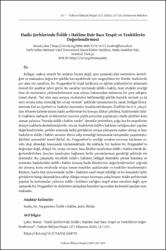
| dc.description.abstract | Belâgat, sadece estetik bir anlatım biçimi değil, aynı zamanda dinî metinlerin derinliğini
ve maksadını doğru bir şekilde kavrayabilmek için vazgeçilmez bir ilimdir. Hadislerde
yer alan söz sanatları, Hz. Peygamber’in irşad üslûbunu ve eğitim yöntemlerini anlamada
önemli bir anahtar işlevi görür. Bu sanatlar içerisinde üslûb-ı hakîm, hem sözdeki inceliği
hem de muhatabın yönlendirilmesini esas alması bakımından müstesna bir yere sahiptir.
Genel olarak, “bir söze veya soruya, muhatabın beklemediği şekilde karşılık vermek ya da
soru sorana talep etmediği bir cevap vermek” şeklinde tanımlanan bu sanat, belâgat literatüründe
Kur’an âyetleri ve hadisler üzerinden örneklendirilmiştir. Özellikle hicrî 8. yüzyıldan
itibaren kaleme alınan hadis şerhlerinde bu konuya dikkat çekilmiş, hadislerdeki üslûb-
ı hakîmin mahiyeti ve hikmetleri üzerine çeşitli yorumlar yapılmıştır. Hadis şârihleri kimi
zaman yalnızca “burada üslûb-ı hakîm vardır” demekle yetinirken, çoğu kez bu tespitlerini
detaylı izahlarla desteklemişlerdir. Ancak, hadislerde üslûb-ı hakîmin varlığına dair yapılan
değerlendirmeler, şerhler arasında farklı görüşlerin ortaya çıkmasına neden olmuş ve bazı
hadislerin üslûb-ı hakîm sanatını ihtiva edip etmediği konusunda tartışmalar yaşanmıştır.
Şârihler arasındaki temel ihtilaf, Hz. Peygamber’in verdiği cevabın sorunun beklenen cevabı
olup olmadığı hususunda toplanmaktadır. Bu noktada, bir hadiste Hz. Peygamber’in
doğrudan değil, dolaylı bir cevap vermesi, bazı âlimler tarafından üslûb-ı hakîm olarak değerlendirilirken,
bazıları tarafından bağlamın farklı yorumlanması gerektiği şeklinde ele
alınmıştır. Bu çalışmada öncelikle üslûb-ı hakîmin belâgat ilmindeki yerine bakılmış ve
ardından hadislerdeki üslûb-ı hakîm konusu hadis âlimlerinin değerlendirmeleri ışığında
ele alınmış, konu etrafında ortaya konan tespitler, açıklamalar ve tenkitler incelenmiştir.
Böylece, hadis ilmi çerçevesinde üslûb-ı hakîmin nasıl tespit edildiği ve bu konudaki farklı
görüşlerin hangi dayanaklara sahip olduğu ortaya konmaya çalışılmıştır. Hadis şerhlerinde
yapılan bu tartışmalar, yalnızca üslûb-ı hakîmin varlığını tespit etme meselesi değil, aynı
zamanda Hz. Peygamber’in sözlerinin anlaşılma biçimleri açısından da önemli ipuçları sunmaktadır. | en_US |
| dc.description.abstract | Rhetoric (balaghah) is not merely an aesthetic form of expression; it is also an indispensable
science for correctly grasping the depth and intent of religious texts. The rhetorical
devices found in hadiths serve as an important key to understanding the Prophet
Muhammad’s style of guidance and methods of education. Among these devices, uslūb alhakīm
holds a distinguished place, as it emphasizes both the subtlety of speech and the
redirection of the audience. Generally defined as “responding to a statement or question
in a way that the interlocutor does not anticipate or giving an answer that the questioner
did not request,” this rhetorical technique has been exemplified in classical rhetoric literature
through Quranic verses and hadiths. From the 8th century Hijri onwards, hadith commentaries
have increasingly drawn attention to this concept, with various interpretations
offered regarding the nature and wisdom of uslūb al-hakīm in hadiths. Some hadith commentators
simply state, “Here, uslūb al-hakīm is present,” while others provide extensive
explanations to support their assessments. However, evaluations regarding the presence
of uslūb al-hakīm in hadiths have led to differing opinions among commentators, giving
rise to debates about whether certain hadiths truly embody this rhetorical technique. The
fundamental point of contention among scholars lies in whether the Prophet’s response
aligns with the expected answer to a given question. In some cases, the Prophet’s indirect
response is interpreted as an instance of uslūb al-hakīm by some scholars, while others argue
that the context should be understood differently. This study first examines the role of
uslūb al-hakīm in the discipline of rhetoric and then explores its presence in hadiths based
on the evaluations of hadith scholars. It analyzes the findings, explanations, and critiques
presented on the subject. In doing so, the study aims to uncover how uslūb al-hakīm is
identified within the science of hadith and the foundations upon which differing scholarly
opinions are based. The discussions found in hadith commentaries regarding this rhetorical
technique not only concern the identification of uslūb al-hakīm but also offer significant
insights into the interpretation of the Prophet’s words. | en_US |
| dc.language.iso | eng | en_US |
| dc.publisher | Trabzon Üniversitesi | en_US |
| dc.relation.isversionof | 10.33718/tid.1648755 | en_US |
| dc.rights | info:eu-repo/semantics/openAccess | en_US |
| dc.subject | Hadis | en_US |
| dc.subject | Hz. Peygamber | en_US |
| dc.subject | Üslûb-ı Hakîm | en_US |
| dc.subject | Şerh | en_US |
| dc.subject | İhtilaf | en_US |
| dc.subject | Hadith | en_US |
| dc.subject | Prophet Muhammad | en_US |
| dc.subject | Uslūb al-Hakīm | en_US |
| dc.subject | Commentary | en_US |
| dc.subject | Dispute | en_US |
| dc.title | Hadis Şerhlerinde Üslûb-ı Hakîme Dair Bazı Tespit ve Tenkitlerin Değerlendirmesi | en_US |
| dc.title.alternative | Evaluation of Some Determinations and Criticisms on the Uslūb al- Hakīm in Hadith Commentaries | en_US |
| dc.type | article | en_US |
| dc.relation.journal | Trabzon İlahiyat Dergisi | en_US |
| dc.contributor.department | FSM Vakıf Üniversitesi, İslâmî İlimler Fakültesi, Temel İslam Bilimleri Bölümü | en_US |
| dc.contributor.authorID | https://orcid.org/0000-0002-0778-4157 | en_US |
| dc.identifier.volume | 12 | en_US |
| dc.identifier.issue | 1 | en_US |
| dc.identifier.startpage | 217 | en_US |
| dc.identifier.endpage | 233 | en_US |
| dc.relation.publicationcategory | Makale - Ulusal Hakemli Dergi - Kurum Öğretim Elemanı | en_US |
| dc.contributor.institutionauthor | Çakır, Mesut | |